
This article is part of The Horn Dispatch’s News Analysis Series, created to help our community understand the news, the context behind it, and why it matters.
To hear an Afaan Borana translation of this English-language article, click on the following link (start at 0:45): https://youtu.be/WHcbzfRYvI4
To hear an Masara translation of this English-language article, click on the following link (start at 0:58): https://youtu.be/WHcbzfRYvI4
September 2026 | The Horn Dispatch | News Analysis

A. Topic
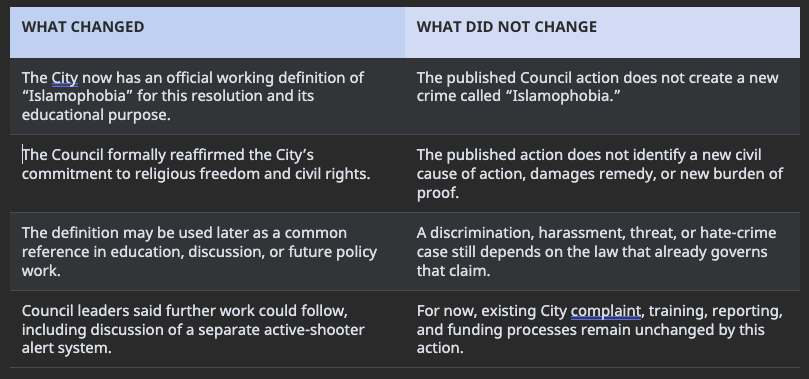
On September 15, 2026, the San Diego City Council voted unanimously (8-0) to adopt a working definition of Islamophobia. The City will use the definition as an educational tool to help identify and speak out against anti-Muslim hate. The action also states the City’s support for religious freedom and civil rights.
The City has made clear that it opposes anti-Muslim hate. The important question for residents is: What actually changed? Based on the Council agenda and public reporting available as of September 16, the immediate change is mainly that the City now has an official definition of Islamophobia. Existing laws and enforcement systems remain unchanged.
B. Location Context
B1. Location of Event
San Diego, California. The action was taken by the San Diego City Council at City Hall. Item 330 was heard during the Council’s September 15 afternoon session and applied citywide.
B2. Impacted Locations
The resolution applies only to the City of San Diego. It does not create a definition for all of California or for the federal government. It mainly affects the City government and people who live in San Diego, especially Muslims and people who may be seen as Muslim.
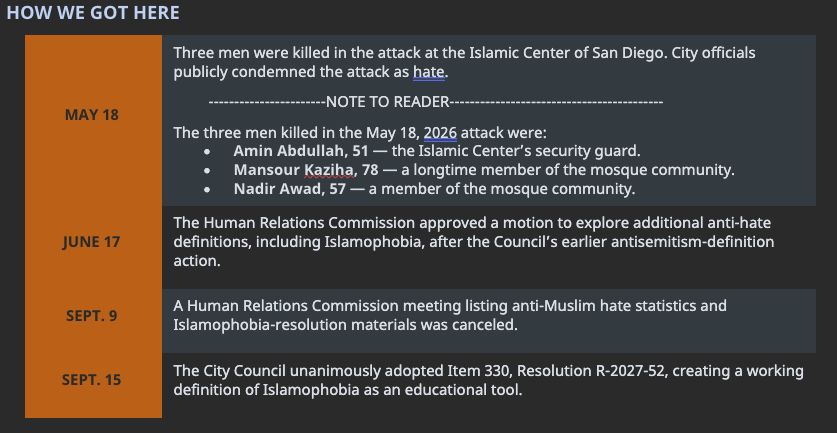
The City Council passed the resolution four months after the May 18 attack at the Islamic Center of San Diego. The City also pointed to research after the attack showing that many Muslims surveyed in San Diego County were worried about their safety.
C. Agreed-Upon Facts
• On September 15, the City Council voted unanimously to adopt the working definition of Islamophobia.
• The definition describes Islamophobia as prejudice, discrimination, hostility, or hatred against Muslims or people believed to be Muslim. It can include words, actions, unfair treatment, exclusion, threats, harassment, or violence.
• Council President Joe LaCava and Councilmember Sean Elo-Rivera sponsored the resolution.
• The City calls the definition an “educational tool.” It is meant to help identify and speak out against anti-Muslim hate and support religious freedom and civil rights.
• The measure is Resolution R-2027-52. It does not change existing criminal or civil laws or create a new enforcement system.
• A resolution is different from an ordinance. An ordinance creates City law. A resolution generally states the City Council’s position or intention. This action was a resolution and did not change the San Diego Municipal Code.
• The resolution came after the May 18 attack at the Islamic Center of San Diego, where three members of the Muslim community were killed.
• City officials also pointed to a UC San Diego survey of Muslims in San Diego County. In the survey, 88% said they felt less safe after the attack, 74% said they were more concerned about their personal safety because they are Muslim, and nearly half worried that threats against Muslims are not taken seriously.
• Councilmember Kent Lee called the resolution the “bare minimum.” Council President LaCava called it “just the beginning.”
• During the same Council discussion, a community activist asked the City to create an active-shooter alert system. Elo-Rivera and LaCava expressed support for working on the idea. That is a separate proposal and was not created by the Islamophobia resolution.
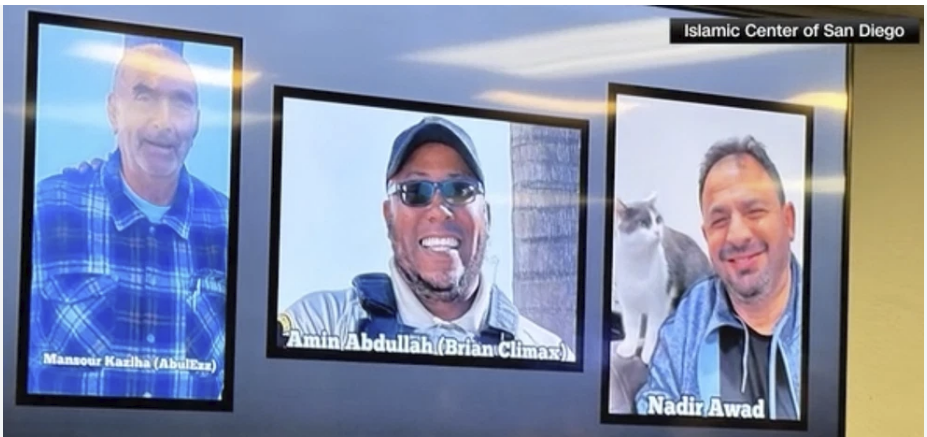
Photos and names of the three men killed in the Islamic Center of San Diego shooting in May 2026.
D. Speculated or Developing Facts
What happens next is less clear. The resolution could become more practically important if the City later connects the definition to specific programs or procedures. The Council agenda for Item 330 does not itself establish those additional steps.
• The City could later use the definition in employee education or other training, but the published agenda does not itself establish a mandatory training program.
• The City could later use the definition to organize data, complaints, or reports, but the published agenda does not itself create a new Islamophobia complaint-tracking system.
• The City could later develop additional safety measures. Council leaders expressed support for exploring an active-shooter alert network, but that is a separate proposal and not a completed program.
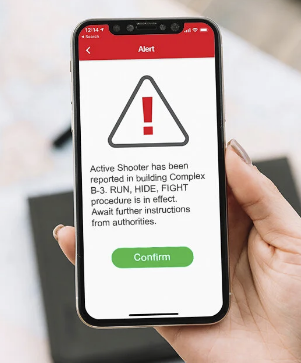
Active-shooter alert network:
A system that could quickly send warnings to people, businesses, religious centers, or community organizations when an active shooting or other serious threat is happening nearby.
E. How This Is Being Covered
EA. Democratic / Progressive Framing
Councilmember Sean Elo-Rivera was one of the main City leaders behind the resolution. He represents City Council District 9, which includes much of City Heights, home to many of San Diego’s immigrant, refugee, and Muslim families.
Elo-Rivera has also been involved with San Diego’s Muslim community before this resolution. He has attended Muslim community events, recognized Ramadan through the City Council, and spoke at the Islamic Center of San Diego after the May 18 attack. Later that month, he read a statement from local Muslim organizations at a City Council meeting when community members could not attend because they were celebrating Eid al-Adha.
That background helps explain why his role in this resolution is important. Elo-Rivera and Council President Joe LaCava brought the proposal to the City Council. Elo-Rivera said some Muslim residents did not feel supported by the City after the May 18 attack. Supporters of the resolution focused on safety, support for the Muslim community, and rebuilding trust after the shooting.
At a press conference before the vote, Elo-Rivera also connected the issue to national politics. He argued that anti-Muslim messages had become part of Republican political campaigning. That was Elo-Rivera’s political argument. It is not part of the resolution itself. The resolution is a City of San Diego action, and the City Council approved it unanimously.
EB. Republican Framing
As of September 28, The Horn Dispatch did not find a public statement from a San Diego Republican elected official or the Republican Party of San Diego County supporting or opposing the resolution. Because of that, we cannot say there is an official local Republican position.
There has been criticism from some commentators. Before the vote, a September 14 OB Rag article called the resolution “strictly performative.” The article questioned whether creating a definition of Islamophobia would actually help prevent hate crimes.
After the vote, conservative outlet PJ Media also criticized the resolution. A September 18 article questioned why the City needed an official definition of Islamophobia and argued that City leaders should be focused on other problems.
These are the views of individual writers and publications. They are not official statements from local Republican leaders. The resolution itself passed the City Council unanimously, 8–0.
F. Attorney Amba’s Message to the East African Diaspora
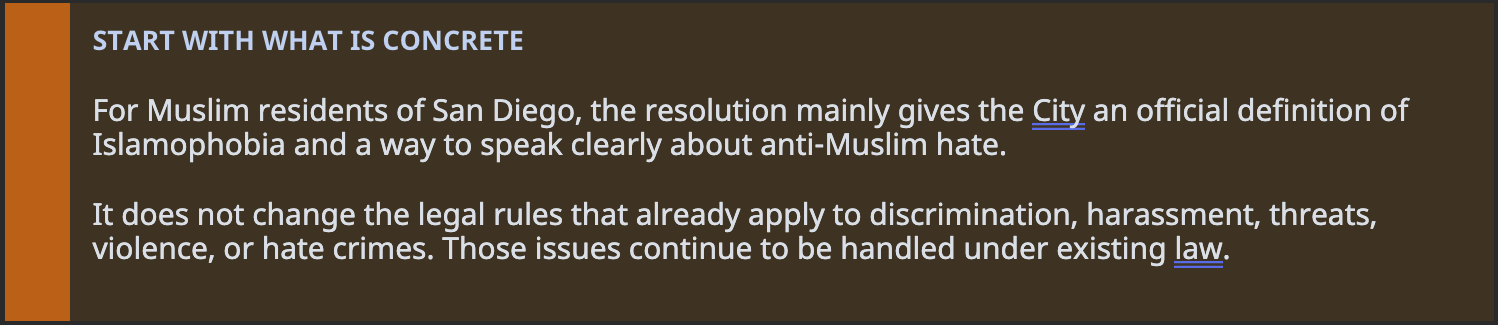
The immediate effect of the September 15 action is principally official recognition.
San Diego has now placed a definition of Islamophobia into the City’s formal record and has again stated that anti-Muslim hate is unacceptable. That message may matter, especially after the May attack and the fear reported by local Muslim residents.
But readers should separate a statement of solidarity from a change in law. A person who had a viable religious-discrimination claim before September 15 still has to prove the applicable legal elements after September 15. A person whose conduct is protected by the First Amendment does not lose that protection merely because the City may describe the conduct as Islamophobic. And conduct that was already illegal remains governed by the laws that made it illegal before this resolution.
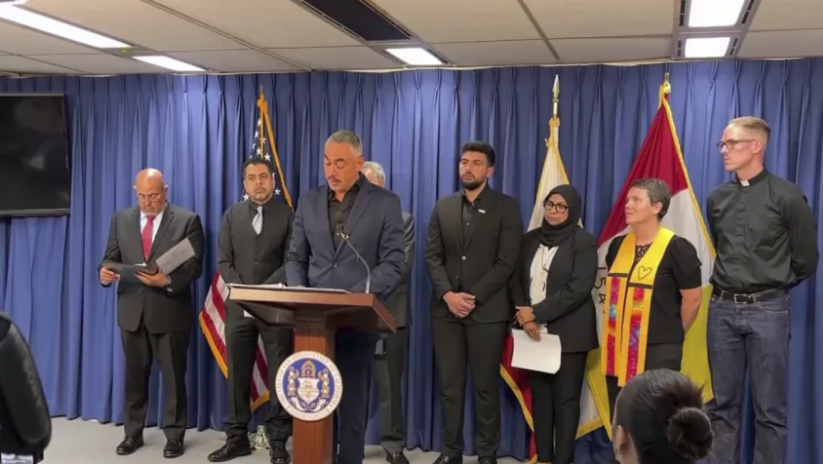
Councilmember Sean Elo-Rivera speaks at a press conference on September 15, 2026.
The City’s support for Muslim residents also did not begin with this vote. Mayor Todd Gloria publicly condemned the May attaack as an act of hate and said an attack on San Diegans because of what they believe or how they pray is an attack on the entire city. The September resolution adds another formal statement to that record; it should not be presented as the moment San Diego first decided to stand with Muslims.
For San Diego’s Muslim community, the resolution sends a clear message: the City Council recognizes concerns about anti-Muslim hate and wants Muslim residents to know that the City stands with them. Coming only months after three Muslim men were killed at the Islamic Center of San Diego, that message is important.
What the resolution will mean over time is less clear. It may help Muslim residents feel recognized and supported by their local government. At the same time, actions focused specifically on Muslims can sometimes bring more public attention, criticism, or political debate. It is possible that some of that attention could lead to backlash against the same community the resolution is meant to support.
For now, we should not assume either result. The resolution is an official statement of support from the City Council and an educational tool for identifying Islamophobia. Whether it leads to greater understanding, stronger community trust, political backlash, or some combination of these will become clearer with time.
For our communities, this resolution can also be understood as part of a longer relationship between San Diego and its Muslim residents. For those of us who have lived in San Diego for many years, public recognition of the Muslim community is not new. Ramadan has long been visible in the city, including public “Ramadan Mubarak” signs and recognition of Muslim community events.
From my own experience living in San Diego on and off since 1999—and having lived in other cities and states—the City’s support for its Muslim community has been noticeable for many years. In that sense, the September 15 resolution does not feel like the beginning of something new. It feels more like a formal acknowledgement of a relationship that was already there, especially after a terrible attack on members of that community.

Mayor Todd Gloria wishing muslims Ramada Mubarak in 2024 on instagram.
What the resolution means beyond that is harder to know. It may strengthen trust and make Muslim residents feel seen and supported. It could also bring political criticism or backlash.
For now, the clearest takeaway is simple: San Diego’s City Council chose to publicly stand with its Muslim community at a difficult time. That also comes during a period of wider debate in the United States and other Western countries about immigration, religion, and belonging. San Diego has generally remained a welcoming place for its Muslim and immigrant communities, but our communities should still pay attention to what is happening around them.
Muslim Americans have the same First Amendment right to practice their religion as every other American. Practice your faith, participate in your community, and know your rights. At the same time, stay informed, be aware of your surroundings, and pay attention to changes happening both here in San Diego and across the country.